Buyer guide
Soft Plyo Box Buying Guide: Sizes, Foam and What to Ask a Supplier
Compare a 3-in-1 foam jump box with a stackable soft plyo set, specify foam, cover and grip, and prepare the sample and quotation details that make supplier offers comparable.
Choose a 3-in-1 foam box when you need several jump heights in one compact product, and a stackable soft plyo set when you need gradual height progressions for beginners and group classes. In both cases the foam, the cover and the grip decide how the box performs, so specify them in writing before you compare prices.
The comparison below uses two models from our gym and strength training range, so the sizes and materials are real catalogue specifications.
3-in-1 foam box vs stackable soft plyo set
3-in-1 foam jump box (TSG-005) | Stackable soft plyo set (TSG-006) | |
|---|---|---|
How height changes | Rotate the box to use three heights | Separate or stack boxes for different heights |
Catalogue sizes | 16 × 20 × 24 in; 20 × 24 × 30 in | Box heights and piece count agreed per order |
Filling | High-density foam | High-density PE foam |
Cover and surface | Textured anti-slip surface | Thick, slip-resistant heavy coated fabric |
Weight | 16 lb for the 20 × 24 × 30 in box | Depends on the agreed configuration |
Best suited to | Home, studio and e-commerce ranges with limited space | Gyms, schools and classes teaching beginners |
Our recommendation: for retail and online ranges, the 3-in-1 jump box covers three heights in a single carton and a single listing. For commercial gyms and coaching programmes, the stackable set lets athletes progress one height at a time with a soft landing.
Describe the intended training use
Begin with the setting and the exercises the boxes are for — plyometrics, step-ups, HIIT or agility drills — and whether you are sourcing for a commercial gym, a training facility or a retail range. Identify the model you are considering and any requirement that differs from the pictured version.
Ask for the intended-use instructions. A catalogue image identifies a design; it does not establish its suitability for every exercise or user.
Foam, cover and grip: what to specify
The foam core decides how the box lands; the cover decides how long it lasts and how well it grips. Foam boxes are light, which makes them easy to move — and also means they can slide on smooth floors, so grip deserves a line of its own in the brief.
- Foam type and density (kg/m³), and whether the core is one block or layered.
- Cover material and thickness, and how seams are reinforced.
- Top and base surfaces: ask how the base grips and test the sample on your own floor type.
- Handles, and hook-and-loop connections if boxes will be stacked.
- The maximum user weight the supplier will confirm in writing for each configuration.
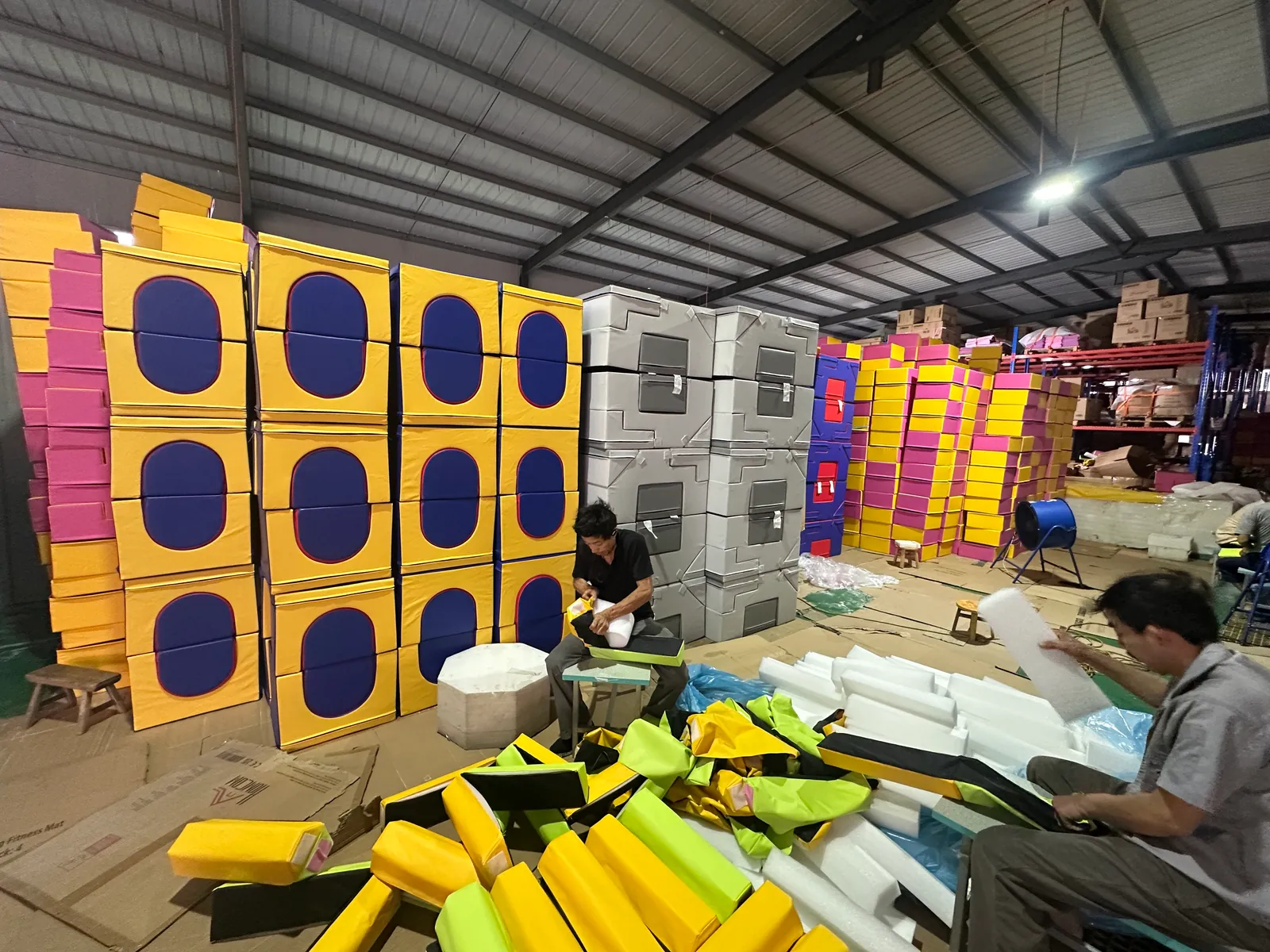
In our workshop, foam cores are fitted into sewn covers by hand, which is why the cover fit and the foam size are agreed together on the sample rather than separately.
Prepare a practical sample checklist
- Exact model and specification sampled, with dimensions checked against your brief.
- Landing feel, shape recovery and grip on your floor.
- Cover finish, colour, stitching and branding position.
- Handles, connections and how the boxes stack.
- Packaging and the documentation your team needs for the intended market.
Photograph the sample and record any changes against that version. Ask for written confirmation of agreed revisions before treating the sample as the reference for the order, and keep colour and artwork approvals with the specification.
Request a complete quotation
Provide quantities for each model or set, your destination and preferred delivery date, and whether you need retail packaging, labels or bulk cartons. Ask for carton dimensions, gross weight and the number of cartons so freight estimates use the same packing arrangement.
The quotation should identify the product version, packing method, delivery terms and any separately priced items such as samples. Put unresolved questions in the brief so they are answered before you place the order.
Frequently asked questions
What sizes do your soft plyo boxes come in?
The 3-in-1 box is catalogued at 16 × 20 × 24 in and 20 × 24 × 30 in. Stackable sets are configured per order, and other sizes can be developed as an OEM / ODM project.
Are soft plyo boxes suitable for beginners?
The stackable set is designed to let beginners learn plyometric jumps with a soft landing. Confirm the intended-use instructions for your market and include them with the product.
What is the minimum order?
Trial orders start from 100 pieces, so you can test the product before committing to volume. Repeat orders are scheduled flexibly around your product plan.
Which documents are available?
CE and CPC documents are available for relevant products; the applicable documents and product scope are confirmed for each product and order. Our facility holds an amfori BSCI social audit and ISO 9001:2015 and ISO 14001:2015 certificates (certified scope: sports mats), which you can inspect on our About page.
Next step
Browse the gym and strength training range — including weightlifting crash pads often ordered alongside plyo boxes — then use the enquiry builder to list models, quantities and your destination. Building a kids’ range too? Read how to choose soft play equipment.
About the author: this guide was prepared by the product team at Nantong Tianshu Sports Products Co., Ltd., a manufacturer of soft sports products and kids sensory training equipment in Rudong, Nantong, China. Since 2018 we have supplied brands, wholesalers, importers and schools from approximately 10,000 m² of production space with a team of around 40, supporting OEM and ODM projects and trial orders from 100 pieces. Learn more about our factory.
Explore related products